
The new EV grant scheme for private individuals is taking shape. People who newly register their EV, certain plug-in hybrids or electric vehicle with a range extender from 1 January 2026 onwards can apply for a grant of between 1,500 and 6,000 euros depending on their vehicle, income and family size, if their income falls below a certain limit. The German federal government agreed on key principles to this effect. The grant applies to the purchase and leasing of new cars. The total funding available for the scheme, 3 billion euros, will be enough for an estimated 800,000 vehicles for the 2026 to 2029 period. New vehicles registered from 1 January 2026 onwards are eligible for the grant. Applications may also be submitted retroactively. The online portal for applications is expected to be operational in May 2026.
Federal Environment Minister Carsten Schneider commented: "With this grant scheme, we want to do something for the environment, for our European automotive industry and for households that would not be able to afford an electric vehicle without support. The German government already took many steps to make EVs attractive as company cars, this scheme now specifically supports private individuals. Funds for the grant scheme will be sufficient for an estimated 800,000 vehicles in the next three to four years. This is a great boost for electric mobility in Germany. And it gives a boost to our domestic automotive industry, which offers a range of powerful EVs. Last year, around 80 percent of newly registered EVs and plug-in hybrids were produced in Europe. The top 10 newly registered EV models also show how strong the German automotive industry is. This year, German manufacturers will be releasing more and cheaper models onto the market."
Grants are available for private households purchasing or leasing new exclusively battery electric vehicles (BEV), certain plug-in hybrid vehicles and BEVs with range extenders. The grant is not contingent on the list price of the vehicle. A basic grant amount of 3,000 euros is available for BEVs and 1,500 euros for plug in hybrids or range extenders. For plug in hybrids and range extenders to be eligible for a grant, their emissions must be lower than 60g CO2/km or they must have an electric range of at least 80 kilometres. For the period from 1 July 2027, the grant for new plug-in hybrids registered from that date will be reviewed with the aim of restructuring based on real-world CO2 emissions. This would enable the greatest possible contribution to climate change mitigation and provide an incentive for the widest possible use of EVs. All vehicles for which a grant is provided must be kept by the owner for at least 36 months.
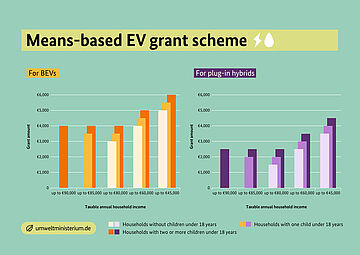
The infographic on the electric vehicle incentive program illustrates the income-based tiering for the purchase of a battery-electric vehicle or an eligible plug-in hybrid.
Means-based support
The income limit is 80,000 euros in taxable annual household income. Tax statements from previous years must be provided as proof. The amount roughly equates to a monthly household net income of 4,800 euros for single people and 5,400 euros for married couples. The income limit increases by 5,000 per child up to 90,000 euros taxable annual household income.
Households earning a maximum of 60,000 euros annual taxable income receive 1,000 euros on top of the basic grant, households earning up to 45,000 euros annual taxable income receive an additional 1,000 euros on top. Furthermore, the grant amount increases by 500 euros per child, with a maximum increase of 1,000 euros. A grant of between 1,500 euros and 6,000 euros may be provided depending on the vehicle type, family size and income. The means-based grant applies equally towards purchase and leasing. This means that a grant of up to 6,000 euros is also provided for leasing BEVs.
Application process
Grant applications may only be submitted after vehicle registration. The application must be submitted no later than one year after the vehicle is registered to the applicant. To shorten processing time and reduce the administrative burden, the process is implemented digitally in so far as possible: Applicants can digitally submit all documents and information required (for instance income tax statements).