
Alpine Convention
Protection and sustainable development of the Alps
The first Alpine Conference in Berchtesgaden in 1989, initiated by the Federal Ministry for the Environment, Nature Conservation and Nuclear Safety, identified an urgent need for action to protect the Alps. The participants agreed to draw up a binding convention under international law for the protection of the Alps.
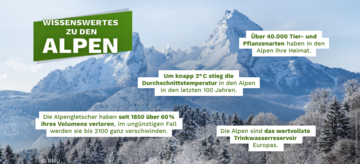
The Alps are home to over 40,000 species of flora and fauna.
The average temperature in the Alps has increased by nearly 2°C in the last 100 years.
Alpine glaciers have lost more than 60 percent of their volume since 1850. In the worst-case scenario, they will disappear completely by 2100.
The Alps are the most important source of drinking water in Europe.
The Alps are home to over 40,000 species of flora and fauna.
The average temperature in the Alps has increased by nearly 2°C in the last 100 years.
Alpine glaciers have lost more than 60 percent of their volume since 1850. In the worst-case scenario, they will disappear completely by 2100.
The Alps are the most important source of drinking water in Europe.
The Alpine Convention was signed in 1991 by the Alpine nations of Austria, France, Germany, Italy, Liechtenstein and Switzerland, as well as the European Community, at the II Alpine Conference, held in Salzburg, Austria. Monaco became a Contracting Party to the Convention on the basis of an additional Protocol. Slovenia signed the Convention on 29 March 1993. The Convention entered into force in 1995. Germany ratified the Convention on the Protection of the Alps (Alpine Convention) of 7 November 1991 by a law of 29 September 1994 (Federal Law Gazette 1994 II, p. 2538).
The Alpine Convention is a framework convention for the protection and sustainable development of the Alpine region. The Contracting Parties undertake to achieve this goal together.
The Alpine Convention calls for a holistic policy approach which is implemented by the Contracting Parties through nine Protocols: spatial planning and sustainable development, nature protection and landscape conservation, mountain farming, mountain forests, tourism, soil conservation, energy, transport, and solution of litigations. The Protocols are independent implementation agreements under international law and have to be ratified individually.
Liechtenstein, Germany, Austria, Slovenia, France and Italy ratified all Protocols between 2002 and 2012, and Monaco and the European Union ratified most between 2003 and 2013. Switzerland has yet not ratified any of the Protocols. In 2010, the Swiss Parliament ultimately decided not to ratify the implementing protocols of the Alpine Convention.
Article 2 of the Alpine Convention envisages further measures in the sectors population and culture, prevention of air pollution and water and waste management. Given that the existing protocols have still not been ratified by all Contracting Parties, the Alpine Conference has not yet made a decision on whether to draw up further Protocols. However, in 2006 the IX Alpine Conference adopted a Declaration on Population and Culture, and in 2016, the XIV Alpine Conference adopted a Declaration on Fostering a Sustainable Economy in the Alps. The XV Alpine Conference in 2019 adopted the Declaration of Innsbruck: Climate-neutral and climate-resilient Alps 2050, while in 2020, the XVI Alpine Conference adopted both the Declaration on Integrated and Sustainable Water Management in the Alps and the Declaration on the Protection of Mountain Biodiversity and its Promotion at International Level.
The VII Alpine Conference decided on the location of the Permanent Secretariat of the Alpine Convention in 2002. Since 2003 the Permanent Secretariat has been based in Innsbruck, Austria, with a branch office in Bolzano/Bozen, Italy. It is currently headed by Secretary General Alenka Smerkolj of Slovenia.
The Multi-Annual Work Programme (MAP) is a tool for ensuring that the Alpine Convention and its Protocols are proactively implemented over the long term. The MAP also sets joint priorities for the activities of the Alpine States. The XVII Alpine Conference (2022) adopted the new Multi-Annual Work Programme 2023-2030. Up to 2030, cooperation will focus on three cross-sectoral priority areas:
- Conserving and valuing Alpine biodiversity and ecosystems
- Taking ambitious climate action
- Enabling a good quality of life for the people in the Alps.
The Alpine Climate Board, one of the thematic working groups of the Alpine Convention, also set up its own website in 2020.
Reports on the State of the Alps have been drawn up on the most important developments in the Alpine region. The topics covered by the reports are determined by the Alpine Conference. To date there have been ten Reports on the State of the Alps:
Reports on the State of the Alps
- Transport and Mobility (2007)
- Water and Water Management Issues (2009)
- Sustainable Rural Development and Innovation (2011)
- Sustainable Tourism in the Alps (2013)
- Demographic changes in the Alps (2015)
- Greening the Economy in the Alpine Region (2016)
- Natural Hazard Risk Governance (2019)
- Air Quality (2020)
- Alpine Towns (2022)
- Quality of Life in the Alps (2024)
The XVIII Alpine Conference agreed to focus the 11th Report on the State of the Alps on glaciers, permafrost and the water cycle.
The Alpine Conference Presidency rotates every two years. Germany held the Presidency in 2015 and 2016. The 2025/2026 Presidency is held by Italy, with Germany set to resume the role in 2027 and 2028. Further information on this will be available in due course.