
Waste water
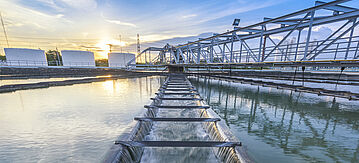
In Germany and the European Union, it is not permitted to discharge untreated waste water into rivers and lakes, regardless of whether it originates from private households, trade or large-scale industry. The Federal Water Act (Wasserhaushaltsgesetz, WHG) stipulates that waste water pollutants must be reduced to the lowest level achievable in line with the best available technology.
Legal basis and responsibilities
According to section 57 (1) of the Federal Water Act, waste water can only be discharged into waters if its pollution load is kept to the lowest level achievable in line with the best available technology. The specific requirements for municipal and industrial or commercial waste water are set out in the Waste Water Ordinance (Abwasserverordnung, AbwV). Waste water management for private households is the responsibility of the local authorities.
The current situation in Germany
In Germany, around 97 percent of waste water from private households and public facilities is processed in waste water treatment plants.
General information on waste water treatment plants
In Germany more than five billion cubic metres of waste water are generated each year by private households, industry and commercial activities. In addition, around three billion cubic metres of rainwater run-off from roads or paved surfaces also flow into the treatment plants. A considerable additional amount of infiltration water enters the sewage system through leaks.
Around 97 percent of the German population is connected to the public sewage system. Waste water from households is collected in the public sewage system and channelled into waste water treatment plants. There are almost 9,000 public plants in Germany.
Micropollutants
Micropollutants will be one of the major challenges for waste water management in the coming years. These are pharmaceutical residues, cosmetics or chemicals that have harmful impacts even in very small amounts. Conventional waste water treatment technologies are not yet able to remove these trace pollutants. To address this issue, European legislation stipulates that by 2045 certain treatment plants must be fitted with technologies such as special membranes or oxidation processes that can remove these pollutants.
Private household waste water management and municipal sewage systems
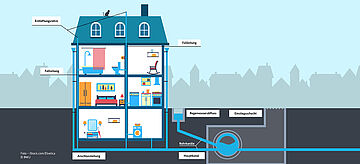
The graphic illustrates drainage from a home into the sewage system. The vent pipes and downpipes ensure that water from the various points in the house reaches the access line. This line, like the rainwater drain, connects to the main line via drain pipes. The main line can be reached via access shafts.