
Today, the Federal Cabinet adopted two legislative proposals put forward by Federal Environment Minister Carsten Schneider to enable Germany to join and implement the United Nations Agreement on Marine Biological Diversity of Areas beyond National Jurisdiction (BBNJ Agreement). The agreement, finalised in 2023, makes designating marine protected areas on the high seas possible at international level for the first time. In addition, there will be environmental impact assessments of human activities in the oceans. The agreement is the first to establish uniform environmental rules for all countries. Unlike other countries, Germany requires two laws to ratify the agreement, a ratifying act and an implementing act. The ratifying act covers Germany’s accession to the agreement as a party. The implementing act (the BBNJ Act) is for adapting national laws to the new international law of the agreement.
Federal Environment Minister Carsten Schneider remarked: “Oceans are vitally important for us. They produce oxygen, provide food and are the largest ecosystem on the planet. However, oceans are under severe pressure due to plastic litter, overfishing, chemicals and climate change. This makes areas where marine nature can heal even more important. Experience has shown that nature regenerates when marine areas become protected areas. The UN BBNJ Agreement is the first to create common global rules for designating marine protected areas on the high seas. It is the biggest success in international environmental policy of the last few years. By ratifying, Germany will be among the parties participating in the first Ocean Conference of the Parties. We are already working with partners in Africa, South America and Asia so that we will soon be able to designate initial marine protected areas.”
The high seas cover around half of the earth’s surface. Legally speaking, these are parts of the ocean beyond territorial waters and national laws, places that belong to everyone and no one. Until now, there were no uniform environmental rules for these areas beyond national jurisdiction.
Now, this biodiversity beyond national jurisdiction will all fall under the BBNJ Agreement. To date, there are 145 signatories, including all EU Member States. On 19 September 2025, a total of 60 countries had ratified the agreement, triggering its entry into force on 17 January 2026. 75 countries and the EU have now ratified the agreement.
A date has not yet been set for the first Conference of the Parties under the new agreement, referred to as the Ocean COP, but August 2026 and January 2027 are being discussed. No protected areas are expected to be established at the first conference. Instead, the COP will lay the groundwork for the cooperation needed to designate protected areas, carry out environmental impact assessments and create transparent and fair use of genetic resources from the ocean, for example for medicines or cosmetics.
Germany is a driving force in international cooperation on ocean protection. The German government is working together with five partner countries in the “Living High Seas” project to draw up initial proposals for marine protected areas beyond national jurisdictions.
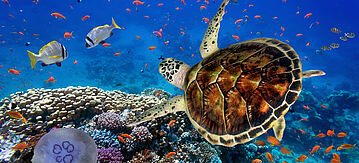
Five potential regions of especially high environmental value have been identified in the preparatory work, for example the Remetau Group of Micronesia. This area of the southwestern Pacific Ocean has coral reefs and seamounts that are home to a wealth of rare endemic species, including endangered seabirds. It links the national territorial waters of Micronesia, Papua New Guinea and Indonesia.