
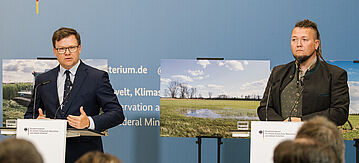
Carsten Schneider presented a new support programme aimed at rewetting 90,000 hectares of land in the next few years. Agriculture and forestry work will continue on this land.
Today, Federal Environment Minister Carsten Schneider presented a new support programme aimed at rewetting 90,000 hectares of land in the next few years. The programme is unique not only because of its scale, but its approach: agriculture and forestry production will continue on the rewetted land, just a bit differently than before. Until the end of 2029, the German government will provide around 1.75 billion euros from the Climate and Transformation Fund to support the transition. The programme is voluntary. Considerable interest from the agriculture and forestry sectors is expected as long-term use of drained peat soils is challenging. The European Commission approved the programme this week.
Federal Environment Minister Carsten Schneider commented: "The peatlands in Germany have been drained over the course of centuries. We are experiencing the consequences today. Groundwater levels are sinking, forests are drying up, and the greenhouse gases being released are heating up the planet. This support programme marks the start of a trend reversal. This funding can give peatland regions in Germany and in particular the farming and forestry sectors a real prospect for the future. Continuing to pursue agriculture on rewetted land enables us to retain water in the landscape without forgoing use. This approach has advantages that benefit everyone: it provides a buffer against heavy rainfall and stores water for periods of drought. Groundwater reserves are replenished, making adequate water available for a large surrounding area. And peatlands can once again become the natural air conditioners for the climate that they were for thousands of years."
The new programme funds planning and implementation of rewetting and provides compensation for value losses in land ownership and use. In addition, it supports the creation of new value chains and products from peatland plants – from fibres for paper and cardboard to insulation, building materials and much more. Experts refer to this use as "paludiculture", taken from the Latin word "palus" for "swamp". The goal now is to make this form of land use possible across large areas of Germany’s drained peat soils. The German federal government is breaking new ground in Germany and the EU with this funding plan.
Today, more than 90 percent of what were originally peat soils have been drained. Only about 100,000 hectares of peatlands remain untouched and waterlogged. Because drained peat soils decompose and continuously release carbon, they become less usable for agriculture over time and lose their value in the long term. Rewetting stops and reverses the decomposition process. This gives agriculture and forestry a prospect for the long term. The areas are also transformed from greenhouse gas emitters – most recently estimated at over 50 million tonnes of emissions – to greenhouse gas sinks.
The new programme is the first to include all steps required for rewetting and the establishment of paludiculture management in four funding modules. The modular approach makes it possible to prepare and submit applications step by step and supports project implementation that takes into account regional and individual needs on areas starting from five hectares in size. This includes, among other things, the necessary advisory services and creation of the legal and technical basis for water management. For the first time, compensation will be provided to land managers for yield losses and to land owners for value lost due to rewetting. The new programme also provides comprehensive support for agriculture and forestry on peat soil areas after successful rewetting. Those interested in funding can generally apply for each module separately and receive funding up to 100 percent for rewetting peat soils and implementing economically viable, climate-friendly forms of use.
The programme will launch with large model projects on peat soil areas of 5,000 hectares or more, which will support the transition to climate-compatible management in peatland regions. These lighthouse regions will pursue a holistic concept encompassing all phases from planning and implementing rewetting to sustainable paludiculture and regional value creation. This goal is to support economic transformation in these regions and create wide-ranging opportunities for the future.
The funding is aimed at all stakeholders who must work together to rewet peat soils used for agriculture and forestry (particularly land owners, land managers, water and soil associations). This programme is the first to address land owners, water and soil associations as well as land managers.
A call for applications will be initiated by the Landwirtschaftliche Rentenbank, Germany’s rural development agency, for financing large-scale model projects (lighthouse regions). At the same time, peatland managers and regional agencies for nature-based climate action in the federal states will be trained to provide information and guidance to potential funding applicants. The development agency will hold special informational events for the other modules of the programme in the coming months.