
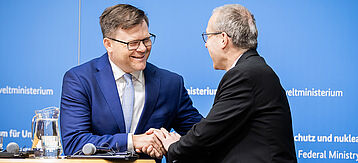
The World Health Organization (WHO/Europe) presented its new Heat–Health Action Plans Guidance today in Berlin, on the occasion of the nationwide Heat Action Day. Every year around the world, extreme heat leads to a rise in heat-related illnesses and health complaints, and even premature deaths. Cardiovascular diseases in particular occur more frequently or worsen under the influence of heat. In particular, urbanisation and the growing proportion of population groups at increased risk, such as older people and those with preexisting health conditions, make prolonged heatwaves a growing threat to public health. The guidelines serve as a scientific framework for government bodies worldwide to effectively organise heat protection measures.
Federal Environment Minister Carsten Schneider: "Climate change is being felt all over the world, including here in Germany and Europe. Alongside extreme weather events such as droughts or heavy rain, it is above all the heat that is causing problems for many people. Protection against heat is also a social issue. After all, those who do not have a garden or a swimming pool and live in overheated flats in concrete-covered urban districts can hardly protect themselves against the heat. What helps is lower CO2 emissions and more preventive measures in both urban and rural areas: urban trees, parks, intact rivers, forests and moors noticeably cool the air and also store water. It is often several degrees cooler under large trees. Nature can help us combat the heat if we let it. That is why this Federal Government is investing more than ever before in these tangible measures against climate change."
WHO Regional Director for Europe, Dr Hans Henri P. Kluge: "Europe is warming faster than any other continent — and we are paying for it in lives. More than 200,000 people across Europe have died from heat in just the last four years. This must end. Heat is a silent killer, but it is not an inevitable one. Today, the new WHO evidence-based guidance we are launching gives authorities a clear roadmap to build the preparedness systems that save lives. Partners like the German Federal Government and the State of Berlin are already showing the way — demonstrating that global standards, when embraced at every level, become local, life-saving action. We have the tools. Now we must use them."
Dr Ina Czyborra, Senator for Senator for Higher Education and Research, Health, and Long-Term Care of the State of Berlin: "Large, densely built-up cities are particularly vulnerable to the dangers of summer heat. That is why Berlin has been actively working for years to protect the city’s population from the heat and takes its public service responsibilities very seriously. This includes not only public communication and a structured approach to extreme heat, but also the long-term maintenance and expansion of parks, green spaces and water bodies, as well as structural heat protection measures. All eight of the core elements recommended in the WHO Guidance are taken into account in Berlin’s heat–health action plan. Many measures are already being implemented, whilst others have a longer-term implementation horizon. One thing is clear: protection from heat is a cross-cutting task that can only be tackled through a joint effort by all administrative departments and levels, and with the involvement of civil society actors."
Europe is a region of the world more severely affected by global warming than many others and is consequently already grappling with frequent heatwaves. Most premature deaths due to extreme heat occurred in Italy, followed by Spain, Germany and Greece, with Greece having the highest number of heat-related deaths per million inhabitants. According to the Robert Koch Institute, there were a total of 2,500 heat-related deaths in Germany last year. Older people and those with pre-existing conditions were particularly affected.
The new WHO Heat–Health Action Plans Guidelines provide government authorities and other stakeholders with evidence-based recommendations around eight core elements, for example on improving local heat-warning systems or risk communication with vulnerable groups. These cover a wide range of measures and decision points which, taken together, are intended to ensure effective heat–health protection. The first WHO guidelines were published in 2008 and have now been updated to reflect the latest findings from research and practice.
In 2017, the Federal Ministry for the Environment (BMUKN) published recommendations for the development of heat–health action plans at regional and local authority level. The BMUKN is currently exploring possible options for a national heat–health action plan as part of a research project. Furthermore, the Federal Government is continuously strengthening the framework for precautionary adaptation to climate change impacts, for example through the Federal Climate Adaptation Act or the German Strategy for Adaptation to Climate Change. Through the funding guidelines 'Climate Adaptation in Social Institutions' and 'Measures for Adapting to the Consequences of Climate Change', the BMUKN supports the development and implementation of climate adaptation strategies in social institutions and local authorities, for example through the funding of climate adaptation managers in currently 200 local authorities.
In Germany, it is the states and local authorities who are primarily responsible for heat protection. For example, the Berlin Senate adopted a state-wide heat–health action plan in 2025. Included therein are 72 measures designed to improve protection from heat for Berlin's population. Communication measures form a major component of this. The public is informed every summer via various analogue and digital media. A heat protection portal provides access to the heat–health action plan, a map of cool places in the city, as well as behavioural advice and communication materials. Furthermore, to strengthen heat protection for patients, for years now Berlin has been building a network that encompasses many different institutions within Berlin’s health and care sector.