
Federal Environment Minister Carsten Schneider presents document at the UN General Assembly in New York
Federal Environment Minister Carsten Schneider unveiled Germany’s roadmap for transitioning away from fossil fuels at the United Nations in New York. Prior to this, the Federal Environment Ministry had presented this roadmap to the Federal Cabinet. This makes Germany the third country, after France and the Netherlands, to present a plan of this kind. At the 2023 UN Climate Change Conference in Dubai, the international community decided to accelerate the transition away from fossil fuels. With the roadmap, Germany is seeking to galvanise the process and prompt as many other nations as possible to finalise their own plans. Transitioning away from fossil fuels is crucial to the success of climate action: 75 percent of global emissions stem from the combustion of coal, oil and gas.
Federal Environment Minister Schneider remarked: "The current global situation is lending new momentum to international climate policy. It is not just extreme weather events around the world that show how urgently more climate action is needed. More and more countries are realising just how costly and dangerous their dependence on fossil fuels is. When the situation in the Strait of Hormuz determines whether people can still afford their daily commute to work, something is seriously wrong. We need to break our dependence on fossil fuels – and we can. The roadmap outlines not only a climate strategy, but also an economic policy strategy. The money we previously spent on importing oil and gas will, in future, be increasingly channelled into creating local value. Transitioning away from fossil fuels combines independence, affordability and climate action. We hope to set an example internationally with our roadmap. I am confident that many other countries will follow suit."
In 2024, fossil fuels still accounted for 65 percent of Germany’s energy consumption: petroleum (36 percent) natural gas (24 percent) and coal (5 percent). Ninety-eight percent of petroleum and 95 percent of natural gas were imported. The total costs of fossil fuel imports in 2024 amounted to 76 billion euros. These costs have risen drastically since the Iran crisis.
Germany’s roadmap focuses on the growing use of renewable energy to generate electricity and on the electrification of transport, heating and industrial processes. Electric technologies such as electric cars and heat pumps are vastly more efficient than fossil-fuel-based alternatives and these technologies are getting better all the time. Every new heat pump and electric car saves Germany from having to import oil and gas and lowers greenhouse gas emissions. Germany will be climate-neutral by 2045 and will be able to operate efficiently and cost-effectively – without being dependent on fossil fuels.
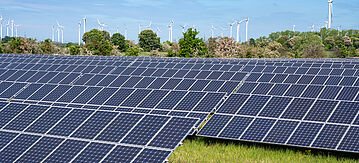
Electricity generation: The share of renewable energy in electricity generation is growing rapidly. It already accounts for around 55 percent of gross electricity consumption in Germany and is set to rise to at least 80 percent by 2030. This will be underpinned by the phase-out of coal no later than 2038 and the expansion of the electricity grids. Additional dispatchable gas-fired power stations will switch to green hydrogen, meaning that by 2045, power generation in Germany will be climate-neutral and fossil-free. This development is supported by the EU Emissions Trading System, which reduces the allowances allocated for fossil fuel power plants every year.
Mobility: The rise of electric mobility is rapidly gathering pace – by August 2026, around a third of new cars registered in Germany were already fully electric. Means-tested grants are providing a boost to income groups who did not previously even consider electric mobility an option. At the same time, the German government is continuing to press ahead with the expansion of charging points.
Heat production: Heat pumps and district heating are replacing oil- and gas-fired heating systems. For the first time, more heat pumps than gas central heating systems were sold in Germany in 2025. This technological development is supported by means-tested grants and regulatory frameworks.
Industry: For industry, the German government is pursuing a strategy of electrification and modernisation. Investments in decarbonisation are supported by funding programmes. This is complemented by the price signals from the EU Emissions Trading System and the protection afforded by the Carbon Border Adjustment Mechanism (CBAM).
Germany is also working with other countries to transition away from fossil fuels. One example is the Energy Transition Partnership with South Africa, which is focused on phasing out coal and expanding electricity grids and renewable energy.
Since last year’s UN Climate Change Conference in Brazil (COP30), transitioning away from fossil fuels has been high on the international agenda. The Brazilian COP30 Presidency is set to publish an international roadmap for transitioning away from fossil fuels in October. In April, 57 pioneering countries, including Germany, met in Santa Marta at the first international conference on transitioning away from fossil fuels to discuss how to successfully phase out coal, oil and gas. After the conference, several work processes were established to strengthen international cooperation on key issues related to the transition. The Turkish and Australian COP31 presidencies are also aiming to further accelerate global electrification.
The roadmap can be found under "Further information".