

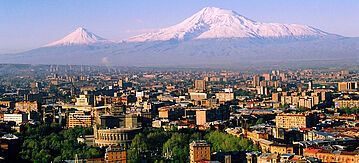
Carsten Schneider calls for more collective action to better protect biodiversity and important natural landscapes
19 October 2026 saw the opening of the 17th UN Biodiversity Conference in the Armenian capital, Yerevan. The motto is "Taking Action for Nature". This will mark the first time the international community has taken stock of the progress towards the targets agreed in 2022 to protect and restore global biodiversity. They include designating at least 30 percent of terrestrial and marine areas as protected areas in order to conserve important natural landscapes worldwide and provide more funding for this purpose. Federal Environment Minister Carsten Schneider is heading up the German delegation and will arrive in Yerevan in the second week of the conference. In 2022, under the Kunming-Montreal Global Biodiversity Framework, the international community committed to stepping up nature conservation. In September Minister Schneider deposited Germany’s instrument of ratification for the UN BBNJ Agreement in New York. The agreement aims to facilitate the designation of marine protected areas in international waters. The conference will run until 30 October 2026.
Federal Environment Minister Schneider remarked: "The natural world protects us – if we protect nature. We need insects to pollinate our crops, soil to grow our food and floodplains to retain flood water. That is why the focus in Yerevan will be the natural foundations of life on Earth. The international community has pledged to halt biodiversity loss by 2030 and to take steps to allow nature to recover. Now we must demonstrate that this pledge can become reality. What is at stake are habitats for flora and fauna, but also the key factors that shape our lives, our prosperity and our security. When species become extinct and soils are stripped of nutrients, harvests fail. When forests are cleared, rivers straightened and mangroves destroyed, people become more vulnerable to droughts and flooding. By preserving an intact natural environment and high levels of biodiversity, we are also tackling the root causes of displacement. We are securing food supplies and supply chains – all these things depend on the natural environment."
Countries have taken the first steps to protect biological diversity and restore important ecosystems. But it is clear that if we take stock, what emerges is a mixed picture. There is no real sign of a turnaround, an effective halting of deforestation, or the loss of species, ecosystems and habitats. The first global review aims to demonstrate where progress has been made and where corrective action is needed, as well as indicating where and how nature conservation measures can be accelerated to get us on track by 2030.
Currently 18.4 percent of global terrestrial areas are protected. More protected areas are in the pipeline. Coastal areas and national marine areas have developed particularly positively – about 23 percent are now protected, as compared to about 1.7 percent of high seas areas.
For example, very little progress has been made on integrating biodiversity into the various sectors of the economy. And more financial and human resources are needed at all levels. In parallel, subsidies that are harmful to biodiversity must be phased out.
Federal Environment Minister Schneider commented: "The international community has made progress, on designating protected areas and restoring ecosystems, to give two examples. But we’re still a long way from where we need to be. We now need to pick up the pace if we are to achieve our common goals. A line on a map has never saved a forest or a coral reef. For that we need local expertise, funding, staffing and a strong local civil society. This year’s UN Biodiversity Conference, under the Armenian Presidency, must further raise awareness of the importance of global nature conservation and species protection, and, if possible, mark a starting point for additional protective initiatives. The worldwide loss of species and ecosystems does not stop at national borders and can only be halted by joint multilateral action. We in Germany also still have our work cut out for us. We have laid the foundations with the National Biodiversity Strategy and the Federal Action Plan on Nature-based Solutions for Climate and Biodiversity."
The new UN BBNJ Agreement is one example of key progress. It covers international waters, which is why it is known as the Biodiversity Beyond National Jurisdiction (BBNJ) Agreement. These areas, which account for about half of the surface area of our planet, together make up the largest contiguous ecosystem on Earth. From majestic whales to deep-sea corals, the high seas are home to unique species that can now be better protected thanks to this Agreement with its universal environmental regulations and the designation of protected maritime areas.
This Agreement makes it possible for the first time to designate protected areas in international waters. Marine mammals can find refuge in these waters and fish stocks can recover there. The Agreement will thus make a crucial contribution to meeting the global pledge to place a total of 30 percent of all marine areas under protection by 2030.
The Global Biodiversity Framework, adopted four years ago at the UN Biodiversity Conference in Montreal, marks a historic milestone in international nature conservation. It consists of four long-term goals for 2050 and 23 action-oriented targets for 2030, including
- Effectively protecting at least 30 percent of global terrestrial and marine areas by 2030
- Restoring at least 30 percent of all degraded ecosystems
- Reducing by at least half the risks posed by pesticides by 2030
- Reducing the global footprint of consumption in an equitable manner, including by halving global food waste
- Increasing financial resources to protect biodiversity
As well as the government delegations from the signatory states, many civil society actors are attending the conference in Yerevan, including representatives of indigenous peoples and local communities, of regions and cities, NGOs and youth delegations as well as experts from the academic, research and business communities and from the financial sector.
Along with the Framework Convention on Climate Change (UNFCCC) and the Convention to Combat Desertification (UNCCD), the Convention on Biological Diversity (CBD) is one of the three Rio Conventions of the United Nations. 2026 is a "Triple Rio COP" year, with conferences of parties of all three conventions taking place. The UNCCD COP was held in August in Mongolia. The current COP17 of the UN Convention on Biological Diversity will be followed in November by the UN Climate Change Conference (COP31) in Turkey.