
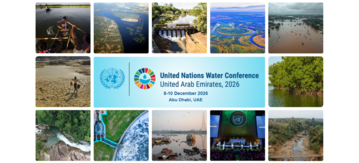
2026 UN Water Conference: A Key Moment for Global Water Governance
Water connects people, societies and countries across borders. It is essential for human health, food security, energy supply, economic development and healthy ecosystems. At the same time, water-related challenges are increasing worldwide due to climate change, growing water demand, and more frequent droughts and floods. These challenges can only be addressed through collective action. International cooperation is essential to protect water resources sustainably, prevent conflicts and strengthen societal resilience.
Against this backdrop, the 2026 UN Water Conference represents a critical opportunity for advancing global water governance. It will bring together United Nations Member States alongside representatives from science, civil society, international organisations, the private sector and financial institutions to accelerate progress towards Sustainable Development Goal 6 (SDG 6) – Clean Water and Sanitation for All – and to strengthen international cooperation on water in the long term.
The 2026 UN Water Conference builds on the momentum of the UN 2023 Water Conference, which marked the first dedicated UN conference on water since 1977 and placed water back at the centre of the international agenda.
Germany is actively contributing to the preparatory process of the 2026 UN Water Conference together with international partners and is committed to strengthening the role of water within multilateral processes and expanding global cooperation on water.
Key Themes of the Conference
The 2026 UN Water Conference will be hosted by Senegal and the United Arab Emirates in December 2026. It is structured around six thematic Interactive Dialogues (IDs), each co-chaired by two UN Member States. These dialogues form the substantive backbone of the Conference:
- ID A: Water for People
- ID B: Water for Prosperity
- ID C: Water for Planet
- ID D: Water for Cooperation
- ID E: Water in Multilateral Processes
- ID F: Investments for Water
Within these Interactive Dialogues, UN Member States and stakeholders will discuss key challenges and opportunities for international water governance. The recommendations emerging from the dialogues will feed into the Conference’s Summary of Proceedings prepared by the co-host and help shape future international action on water.
Germany and Mexico are co-chairs of Interactive Dialogue E: Water in Multilateral Processes.
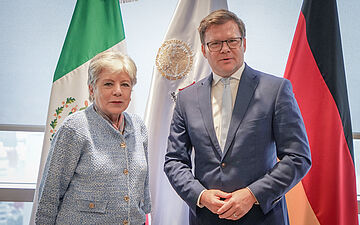
Mexico's Secretary of Environment and Natural Resources Alicia Bárcena Ibarra and Germany’s Environment Minister Carsten Schneider as co-chairs of ID E.
Interactive Dialogue E: Water in Multilateral Processes
Interactive Dialogue E addresses one of the central challenges of global water governance. Water is increasingly recognised as one of the most critical resources for sustainable development and is fundamental to sustainable progress in numerous global agendas. At the same time, international water governance remains fragmented, with limited political coordination and insufficient intergovernmental dialogue.
The objective of the dialogue is therefore to explore ways of strengthening institutional cooperation on water within the United Nations system and to reinforce water as a cross-cutting issue across international processes.
For the co-chairs, Mexico and Germany, key questions include how a future intergovernmental process on water under the United Nations could be designed and how water can be more effectively integrated into other international agendas, including climate and biodiversity processes and a post-2030 agenda.
To this end, Germany and Mexico are working closely with UN Member States, international organizations and relevant stakeholders to develop practical recommendations that can strengthen global water governance.
Opportunities to engage on the Road to the 2026 UN Water Conference
Preparations for the 2026 UN Water Conference are taking place through an open, transparent and participatory international process. In the lead-up to the Conference, UN Member States, international organizations and a broad range of stakeholders are meeting throughout various international events to identify priorities and shape the future global water agenda. The preparatory process began with the Preparatory Meeting held in Dakar, Senegal, on 26 and 27 January 2026. It will culminate in the UN Water Conference, taking place in Abu Dhabi from 8 to 10 December 2026.
For Interactive Dialogue E, Germany and Mexico are facilitating an inclusive preparatory process that explicitly incorporates stakeholder perspectives alongside those of UN Member States. Various consultation and engagement formats are being organised throughout the year, including discussions during the Dakar Preparatory Meeting, the High-level Political Forum on Sustainable Development (HLPF), and World Water Week in Stockholm. In addition, an online consultation is planned for July 2026. To support transparency and inform discussions, Germany and Mexico publish "State of Play" reports summarising the outcomes of consultations and highlighting emerging priorities.
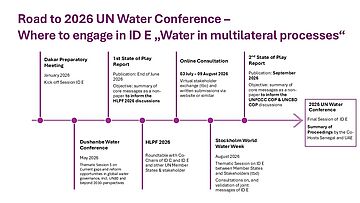
The overview presents key milestones and engagement opportunities throughout the preparatory process leading up to the 2026 UN Water Conference.