
Water as a key resource for our future – shaping global water policy

Water is a vital resource for sustainable development, climate action and biodiversity conservation. International policy placing greater focus on water.
Water is a common thread that runs through all areas of our lives. It is the basis for food, energy, health, economic development and intact ecosystems and a key resource for achieving our global climate and environmental targets and the United Nations 2030 Agenda for Sustainable Development.
At the same time, water resources around the world are under increasing pressure from scarcity, pollution and overuse. Over 2.2 billion people do not have guaranteed access to clean drinking water, and by 2050 around half of the global population could be suffering the effects of water stress. In addition, climate change is significantly influencing the global water cycle. As a result, extreme weather events like droughts and floods are increasing worldwide.
In Germany, too, we are feeling the impacts of global change – from drier summers to severe flooding. Global water protection therefore means one thing above all: protecting our health and safety for our economy and nature and thus preserving our foundations of life, both here in Germany and worldwide.
Cooperation is essential for global water policy
Water is not only vital, it is also a key task for the future, which requires closer cooperation between countries. To date, there is no independent intergovernmental body or comprehensive global international agreement on water like there is for climate and biodiversity. Water is a cross-cutting issue that links many policy areas, from environment, climate and agriculture to health and development.
This complexity offers opportunities for cross-sector solutions. At the same time, however, it makes clear political governance and prioritisation more challenging. The United Nations approach to water is also fragmented, distributing the issue across various organisations: Over 30 institutions work on this issue, but with only limited coordination from UN-Water to date.
Against this background, international cooperation is increasingly focussing on global water policy. The Federal Environment Ministry is therefore committed to strengthening global water governance mechanisms. These include a strong UN-Water as the coordinating mechanism within the UN system and a regular intergovernmental dialogue.
A look back at the 2023 UN Water Conference
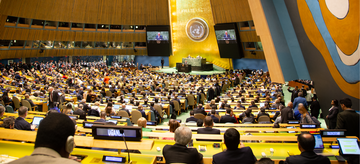
The 2023 UN Water Conference marked the first time since 1977 that water was independently negotiated at the level of the United Nations. The Federal Environment Ministry’s contributions to the conference included five voluntary commitments. In addition, the Ministry actively advocated improved global water governance, including calling on the UN Secretary General to establish a Special Envoy on Water.
The Federal Environment Ministry was involved in the preparatory process for the 2023 UN Water Conference. An important contribution to this was made by the Bonn Water Dialogues, an international dialogue process in which Germany joined with UN member states and representatives of international organisations, politics, business and civil society to develop political recommendations for action. These recommendations were presented in a high-level international conference in July 2021 and informed the 2023 UN Water Conference.
2026 UN Water Conference: Global water process is gaining momentum
The 2023 UN Water Conference made clear that the international community benefits from intergovernmental dialogue: it creates a common understanding, promotes partnerships and encourages results-oriented initiatives. In the follow-up to the Conference, the UN member states adopted a General Assembly Resolution stipulating that the next UN Water Conference would be held in 2026. The Conference will address all dimensions of Sustainable Development Goal 6 "Water and sanitation for all", a goal that still requires significant global action.
The 2026 UN Water Conference will bring together the UN member states and provide a key opportunity to strengthen intergovernmental dialogue and achieve concrete progress towards the sustainable and equitable use of water resources.
Germany is actively shaping this water process together with partners and is advocating strengthening global water governance and further expanding coordination structures within the United Nations. Sustainable management of water resources contributes to regional stability, helps protect livelihoods and secure economic development, and is therefore a top priority of the German government.
In this context, Germany will join with Mexico to chair one of the six thematic dialogues of the 2026 UN Water Conference. Interactive dialogue 5: Water in Multilateral Processes aims to establish an intergovernmental process on water and better integrate water in other international policy areas such as climate action and nature conservation.
UN System-wide Strategy for Water and Sanitation
To counteract the fragmented work of the United Nations on water, during the 2023 UN Water Conference the German Federal Government explicitly advocated an overarching and system-wide approach to water. This means that UN organisations should align their strategies and activities more closely and promote cooperation and synergies in order to use scarce resources more efficiently and better support member states in achieving SDG 6. The development of a UN System-wide Strategy for Water and Sanitation was a focus of the 2023 UN Water Conference and was called for by the member states in a follow-up General Assembly Resolution. The strategy was developed by the UN Secretary-General with the support of UN-Water and officially presented in July 2024. This marks an important step in overcoming the fragmented approach within the UN system in the area of water and sanitation.
Germany strengthens global water policy and international cooperation
Germany supports processes initiated within the framework of the UN Water Conference through further initiatives and international cooperation as follows:
- Anchoring water in international processes:
In intergovernmental negotiations on issues such as climate, biodiversity and desertification, Germany is committed to greater consideration of water as a connecting element. This is particularly important in the context of more frequent extreme events such as droughts and floods. - Cooperation with international partners:
In cooperation with organisations such as UN-Water, UNEP and UNESCO, mechanisms are being strengthened to support member states in implementing global water targets. - Long-term multilateral engagement:
To improve cross-border cooperation and access to clean drinking water and sanitation, Germany has been involved in international agreements such as the Water Convention and the Protocol on Water and Health for many years. - Strengthening global coordination:
In addition, in multilateral forums, Germany is advocating greater coherence in global water governance, including through initiatives such as the G7 Water Coalition. - Initiatives like World Water Day on 22 March, which is observed annually by the United Nations, also help to raise global awareness of the importance of water. Many countries, including Germany, are involved and contribute to this initiative with a variety of measures.
The coming years offer an opportunity to decisively strengthen global cooperation in the water sector and promote sustainable solutions for the equitable use of water resources. This process is based on the commitment of many actors at international, national and local level.