
General information on waste water treatment plants
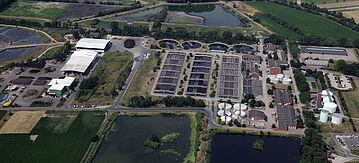
Around 97 percent of the German population is connected to the public sewage system. Waste water is treated in around 9,000 treatment plants. Local authorities are responsible for waste water management unless this responsibility is delegated to another entity. There are also waste water treatment plants in private industrial and commercial facilities as well as small private treatment installations.
Waste water generally undergoes three stages of treatment:
- a physical stage
- a biological stage without deliberate removal of nutrients such as nitrogen and phosphates
- an additional biological stage with targeted nutrient elimination
Three-stage treatment has led to an encouraging increase in the oxygen content in all water bodies, which improves the living conditions for fish and other aquatic organisms.
According to the requirements of EU Directive 2024/3019 concerning urban wastewater treatment, certain treatment plants must be equipped by 2045 with a fourth treatment stage to reduce micropollutants.
Treatment stages in a modern waste water treatment plant
Primary treatment = physical treatment of waste water
- The waste water passes through a bar screen which holds back larger solid objects such as paper, bottles, branches and tins. These are removed by an automated rake.
- The sewage channel broadens out into the grit chamber, reducing the speed of the incoming waste water and allowing coarser particles such as gravel and sand, which are heavier than water, to settle at the bottom.
- The water is retained for approximately two hours in the primary settling tank. In this large rectangular or round tank, fine suspended particles can settle as sludge at the bottom. This raw sludge is removed, thickened and transferred to a digester. Light particles floating on the water's surface such as fat and mineral oil are skimmed off and discharged into a separate tank.
These first three processes make up the primary treatment stage. As this involves purely physical treatment of the waste water, it is also referred to as the physical treatment stage. Primary treatment removes about 30 percent of the total polluting matter from the inflowing raw waste water.
Secondary treatment = biological waste water treatment
- The secondary or biological treatment stage harnesses a natural process. The sewage liquor is passed into an aeration tank. In an activated sludge process, oxygen is injected into the liquor to create favourable conditions for microorganisms which feed on and digest the dissolved organic particles in the effluent.
- The bacteria form colonies or flocs that sink to the bottom in the secondary settling tank or can be pumped back into the aeration tank. After completion of the first two treatment stages, most impurities have been removed, except for the nutrients phosphorous and nitrogen.
Tertiary treatment = nutrient reduction
Waste water is contaminated with the nutrients nitrogen and phosphorous and must pass through additional processing to reduce these pollutants. As an example, this is the typical process for removing phosphorous:
- In this stage, the effluent undergoes mixing, and a dosing pump injects it with a chemical solution.
- This solution, a precipitant, reacts chemically with the phosphates, forming a water-insoluble compound. The residual contaminants form flocs that settle in a subsequent tank as sludge, which is thickened and transferred to the digester.
- The treated waste water can now be discharged into natural waters.
Sludge treatment and disposal
The sludge accumulated from the various settling tanks has a water content of around 98 percent.
- The addition of thickening agents helps to bring this down to 96 percent, reducing the sludge volume by half.
- At this point, the sludge is transferred into an anaerobic digester where a fermentation process at around 35 degrees Celsius takes place. The bacteria generate digester gas that is about two-thirds methane and one-third carbon dioxide.
- This gas is stored in a separate tank to be used as fuel for generating electricity or heating.
- After around four weeks, the digestion process is complete. The odour-free sludge can be discharged for further dewatering.
- The phosphorous contained in sewage sludge is a critical raw material that can be reclaimed in further treatment steps.