
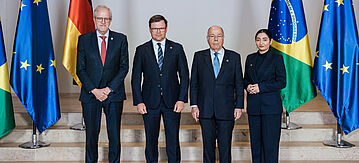
Federal Environment Minister Carsten Schneider took part in the German-Brazilian intergovernmental consultations in Hanover today. He and Brazilian Foreign Minister Mauro Vieira jointly declared their countries’ intention to expand their existing climate dialogue. Building on this, Brazil and Germany intend to deepen their cooperation on environmental protection in future. To that end, Minister Schneider and his Brazilian counterpart, João Capobianco, signed further cooperation agreements on circular economy and fighting environmental crime.
Federal Environment Minister Carsten Schneider remarked: "Brazil and Germany have a strong partnership for global environmental protection and climate action. Given the difficult global situation, reliable partnerships are more important than ever. Brazil and Germany have successfully cooperated on environmental protection and climate action for a long time. We intend to deepen that cooperation in future, working together to safeguard resources with circular economy models and to put a stop to illegal activities."
In 2023, the governments of Germany and Brazil launched an inter-ministerial Partnership for a Socially Just and Ecological Transformation. Under its aegis, both countries’ environment ministries have been pushing for ambitious environmental policy and intensified their collaboration on forest conservation, the decarbonisation of industry and adaptation to climate change, and their cooperation in multilateral formats such as the G20 and the UN Climate Change Conference COP30. That successful cooperation is now being expanded.
With their new Joint Declaration of Intent on a High-Level Strategic Dialogue on Climate Action and Ambition, Brazil and Germany are perpetuating their successful strategic exchange of views. The bilateral dialogue will continue for another three years, focusing on climate negotiations and specific issues relating to the effective implementation of climate action, such as the decarbonisation of industry and the mobilisation of private sector finance. Alongside the political dialogue, the "Track 1.5" dialogue among climate experts from academia and civil society, chaired by the President of the German Environment Agency (UBA) and the head of the Brazilian Forum on Climate Change (FBMC), will be maintained.
Brazil and Germany also wish to cooperate more closely on circular economy and fighting environmental crime. To that end, the two countries will first establish standing working structures, such as expert groups, with a view to actively involving representatives of their governments as well as of think tanks, universities, businesses and civil society.
Brazil is the largest economy in Latin America and Germany’s most important trading partner in the region. Moreover, Brazil is an important partner to Germany in shaping key multilateral processes. Brazil is one of the most biodiverse countries on the planet and possesses forested areas which are vital to the global climate. This makes it one of the most important partner countries for the Federal Environment Ministry's bilateral cooperation.