
Coordination Unit Climate-neutral Federal Administration (KKB)
Under the Federal Climate Action Act (Klimaschutzgesetz, KSG), the German government set the goal of achieving climate neutrality within the federal administration by 2030 and net greenhouse gas neutrality by 2045. As it strives to achieve this target, the federal administration has a special responsibility to lead by example. This role is explicitly outlined in the Federal Climate Action Act and in the Climate Action Programme 2030. To help meet the goal of a climate-neutral federal administration by 2030, the Coordination Unit Climate-neutral Federal Administration (KKB) was established based on a resolution adopted in December 2019 by the State Secretaries’ Committee for Sustainable Development.
The KKB’s remit is diverse: its primary responsibility is to draw up measures that set out specific and necessary guidelines to put the federal authorities on the path to climate neutrality. The German government has already adopted a wide range of measures in various legal contexts. An overview of the most important measures that serve the goal of a climate-neutral federal administration was compiled for COP28 and incorporated into a "Roadmap for a climate and greenhouse gas-neutral federal administration". This roadmap is updated annually.
In addition, the KKB works closely with other authorities to develop specific proposals and collect ideas and best practices on how to prevent or at least reduce greenhouse gas (GHG) emissions in day-to-day administrative work in the relevant action areas. The KKB is supported in its work by the Service and Advice Center for Support for the Coordination Unit Climate-neutral Federal Administration at the German Environment Agency. Furthermore, the KKB engages in regular discussions with the federal authorities and federal states to draw from their diverse experiences to develop new ideas in the transition to climate neutrality and to further enhance the administration’s function as a role model.
The climate footprint of the federal administration
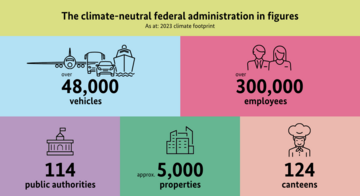
To measure progress towards the goal of a climate-neutral federal administration, the KKB compiles an annual climate footprint for the federal administration. Reliable data is indispensable for determining the climate footprint. The challenge lies in identifying and processing data on key emission sources as comprehensively as possible, yet still in a way that is practical for the federal authorities. The KKB bases its approach on the Greenhouse Gas (GHG) Protocol. The federal administration’s climate footprint consists of Scope 1 emissions (direct emissions), Scope 2 emissions (indirect emissions) and emissions caused by travel on official business (indirect greenhouse gas emissions from upstream and downstream processes). To determine the footprint, the KKB has developed a framework to systematically collect the emissions-related data from the 115 relevant federal administrations. This IT-supported data collection process was first trialled for the 2021 consumption year.
Based on the experience gained and subsequent improvements, the KKB has complied an annual carbon footprint from the 2022 consumption year onwards. It serves as a basis for systematically reducing greenhouse gas emissions within the federal administration.
The diagram shows the emission sources recorded by the federal administration:
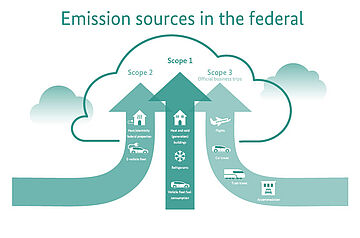
For the carbon footprint of the federal administration, greenhouse gas emissions from electricity consumption are calculated based on the GHG Protocol guidelines using both a location-based and a market-based approach. The results are shown side by side in two separate footprints. The location-based approach takes into account the average greenhouse gas emissions of the electricity supplied at the point of consumption (= German electricity mix). In contrast, the market-based approach takes into account the electricity a consumer has contracted to purchase, for example electricity from renewable energy sources. Detailed background information can be found in a document on how green electricity is handled when accounting for greenhouse gas emissions from electricity consumption in the climate footprint of the federal administration. This document is only available in German.

Action areas for a climate-neutral federal administration
Action areas

EMAS: Support for the introduction of environmental management systems
The federal authorities are provided with support services for the introduction and maintenance of environmental management systems under the EMAS Regulation on the federal government’s electronic procurement platform (Kaufhaus des Bundes). They can also receive expert evaluation and training services for EMAS certification under a number of dedicated framework agreements concluded by the Procurement Office of the Federal Ministry of the Interior

[Translate to English:] Empfehlung
The KKB’s long-term recommendation on energy saving based on the immediate measures
To ensure effective energy savings, the KKB recommends that the relevant measures, which were introduced in response to Russia’s war of aggression against Ukraine in February 2022, be continued in the long term. Saving energy – and therefore also lowering CO2 emissions – continues to be essential. In this way, the federal administration is acting as a role model in accordance with the Federal Climate Action Act and is moving closer to its goal of becoming climate-neutral by 2030. But it also makes sense given the energy-saving requirements for public authorities in terms of final energy consumption, as set out in section 6(1), first sentence, of the Energy Efficiency Act.
In June 2022, in the context of the war in Ukraine, the KKB had consolidated inter-ministerial proposals for ten measures that could be implemented immediately and recommended them for review and implementation within the federal administration on a voluntary basis. In the winter of 2022/23, these requirements and those set out in the Ordinance on Securing the Energy Supply through Rapid Impact Measures (EnSikuMaV) for public non-residential buildings, which remained in force until April 2023, were updated.
For the autumn/winter 2023-2024 season, the KKB recommended continuing the immediate measures and requirements set out in the EnSikuMaV, which has since come to an end. This was intended to ensure that the authorities continued their efforts to reduce CO2 emissions and that the federal administration continued to lead by example. This issue is no less relevant today. The successes achieved through energy-saving measures should be maintained.

International dialogue and cooperation
Germany and many other countries are promoting the transformation of the economy and society not only by setting an example within their own public administrations, but also by acting as drivers of this transformation through their substantial procurement volumes.
Greening Government Initiative
The Greening Government Initiative (GGI) was launched at COP26 in Glasgow in 2021 to promote networking and to learn from one another. Germany was one of the first countries to join the GGI, which now has around 50 members. The KKB participates in the well-established dialogue formats on best practices and current climate policy challenges.
Net-Zero Government Initiative
Under the Net-Zero Government Initiative, which was initiated at COP27 in 2022, the signatories committed to making their administrations climate-neutral no later than 2050. The Initiative stresses the responsibility governments have to lead by example in tackling climate change given their role as large energy consumers, vehicle fleet owners, real estate holders and purchasers of goods and services. With its goal to achieve net zero in its federal administration by 2045 or sooner, Germany is one of the Initiative’s more ambitious members. Thirty countries from different parts of the world have joined the Initiative so far.
The members of the Net-Zero Government Initiative submitted national roadmaps for COP28 in 2023, setting out each country’s path towards the goal of greenhouse gas neutrality. A related event took place at COP28 in Dubai. The German roadmap sets out the federal administration’s path to becoming climate-neutral by 2030 and, in the longer term, achieving net-zero greenhouse gas emissions by 2045. It sets out the key measures currently being taken by the federal government to achieve these goals.