
Today the United Nations Environment Programme (UNEP) published its report "Limiting overshoot – Navigating exceedance of 1.5°C and pathways towards return". The report warns that we are on a pathway to exceed the 1.5-degree limit. Urgent action is essential in order to minimise the duration and extent of the overshoot. To limit the dangerous impacts of climate change effectively, in addition to drastically cutting greenhouse gas emissions, we also have to remove greenhouse gases already in the atmosphere.
Federal Environment Minister Carsten Schneider remarked: "Every tenth of a degree less global warming protects people, nature and economies. The faster we reduce emissions now, the less serious the damage and the less CO2 we will have to remove from the atmosphere in future. That is why Germany is taking a three-pronged approach: the first priority is to prevent and reduce greenhouse gas emissions. This is the simplest and cheapest solution for curbing climate change. Secondly, we are pursuing nature-based climate action by strengthening natural climate sinks such as forests, peatlands and soils. Thirdly, we are preparing to scale up new technologies for permanently removing carbon dioxide from the atmosphere. The goal must be to limit global warming to 1.5 degrees again as quickly as possible, so that climate change does not overwhelm humankind."
With its Federal Climate Action Act, Germany has committed to achieving greenhouse gas neutrality by 2045 and net negative emissions after 2050. Germany’s net negative emissions target will help get the international community back on track for the 1.5-degree pathway.
First element: consistently reducing emissions. The UNEP report reiterates that effective climate action hinges on the rapid reduction of greenhouse gas emissions. The German government also prioritises emissions reduction and stands by the legal reduction targets set out in the Federal Climate Action Act. In the Climate Action Programme 2026 that it adopted in March, the German government introduced further measures for the energy, industry, buildings, transport and agriculture sectors. 67 measures aim to save another 25 million tonnes of CO2 by 2030. They include the expansion of wind energy, electrification of industry and transport, climate-friendlier heat networks and circular economy measures. An additional eight million euros will be provided for the new measures from 2027 to 2030. Thus, taking climate action will also modernise Germany and make the country less dependent on fossil fuel imports.
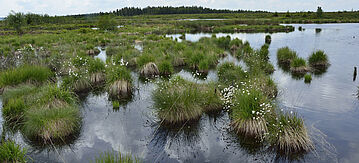
Second element: strengthening nature-based climate action. Forests, peatlands, soils, floodplains, water bodies and seas can store large quantities of carbon. At the same time, many natural carbon sinks are under pressure from climate change and human use. With its Federal Action Plan on Nature-based Solutions for Climate and Biodiversity, the German government is strengthening and restoring these ecosystems and making them more resilient. These measures have many other benefits besides combatting climate change. Intact peatlands, forests and floodplains, for example, also act as natural water reservoirs which can protect regions from drought.
Third element: advancing innovative carbon dioxide removal technology. Even with ambitious climate policy, there will still be unavoidable residual emissions in the long term, especially in agriculture and certain industrial processes. To compensate for these and to achieve net negative emissions after 2050, Germany will also have to remove carbon dioxide from the atmosphere and store it permanently. For this reason, the German government is currently coordinating its long-term strategy for removing carbon dioxide from the atmosphere. The strategy will establish the framework for scaling up technical and other novel carbon sinks and provide the basis for determining the technical sink targets required under the Federal Climate Action Act. The Federal Environment Ministry is also working on measures to promote investment and create market incentives for new carbon dioxide removal technologies.
The German government will continue its efforts to ensure that the international community resolutely pursues the Paris Agreement goals. Exceedance of the 1.5-degree target does not alter the course of our climate policy: the smaller and briefer the overshoot, the less serious the risks for humans and ecosystems and the more realistic the possibility of again reducing global warming in the long term. UNEP stresses that rapid emission reductions are essential in this context and will also lower our dependence on large-scale carbon dioxide removal in future.