

United Nations Environment Programme (UNEP)
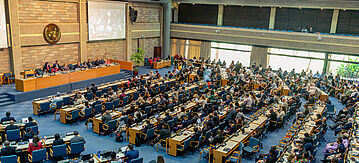
The United Nations Environment Programme (UNEP), which has its headquarters in Nairobi, was founded in 1972 at the United Nations Conference on the Human Environment. UNEP is the only United Nations body focussing exclusively on the environment. In accordance with its mandate, UNEP is "the leading global environmental authority". It coordinates the UN's environmental activities, draws up comprehensive reports on the global state of the environment, develops political and legal instruments for international environmental protection and offers consulting services to interested countries. UNEP is headed by Executive Director Inger Andersen. Previous Executive Directors include Germany's former environment minister Klaus Töpfer, former UNDP Administrator Achim Steiner and Norway's former environment minister Erik Solheim. At the United Nations Conference on Sustainable Development (Rio+20) in Rio de Janeiro in June 2012, the role of UNEP as the voice of the environment within the UN system was significantly strengthened.
UN Environment Assembly
Pursuant to a UNEP Governing Council decision of February 2013, the main decision-making body is the UN Environment Assembly (UNEA), in which all UN Member States are represented. UNEA decisions are prepared by the Committee of Permanent Representatives, a subsidiary organ.
Since June 2014, the UN Environment Assembly has been meeting every two years. The seventh meeting, UNEA-7, took place in Nairobi from 8 to 12 December 2025, focussing on "Advancing sustainable solutions for a resilient planet". UNEA-8 will convene from 6 to 10 December 2027.
The UN Environment Assembly is UNEP's central governing body and its decisions set the priorities for UNEP's work. It also sets priorities for global environmental policy, advises the UN system on environmental policy issues, provides recommendations on new environmental challenges, examines existing practices, encourages the exchange of experiences, organises dialogues with industry and all civil society groups and promotes partnerships that pursue environmental objectives and mobilise resources.
The UNEA-8 Bureau was elected for a period of two years at the closure of UNEA-7. It is composed of ten members: one President, eight Vice Presidents and one Rapporteur, with two members representing each of the five United Nations regions. Germany's State Secretary Jochen Flasbarth was elected to the UNEA-8 Bureau as Vice President for the western European regional group. Jamaica holds the presidency of UNEA-8.
The Committee of Permanent Representatives (CPR), which meets four times a year, is UNEA's permanent subsidiary organ, comprising representatives from countries accredited in Nairobi, who monitor UNEP’s work between UNEA sessions, advise UNEA and convene programmatic debates. As the CPR communicates directly with UNEP it is an important link between UNEP and national governments. Every two years, immediately before the UNEA session, the CPR meets as an Open-ended CPR with representatives from the capitals and civil society groups to prepare the Environment Assembly.
UNEP is headed by an Executive Director and a Deputy Executive Director. They are supported by an Executive Office. UNEP is divided into seven divisions, and offices such as the Office of Science, Governance Affairs Office, Evaluation Office and Regional Offices. The divisions are:
- Communication Division
- Climate Change Division
- Ecosystems Division
- Law Division
- Industry and Economy Division
- Policy and Programme Division
- Corporate Services Division
UNEP also has six regional offices for Africa, Asia and the Pacific, Europe, Latin America and the Caribbean, North America and West Asia, which ensure close cooperation with these regions.
Multilateral environmental agreements
Since its founding UNEP has played a key role in the development of multilateral environmental agreements (MEAs). The secretariats of numerous global and regional environmental agreements are currently based at UNEP. These include:
and the following Agreements under the CMS:
In addition, UNEP has responsibility for the secretariats of other regional Agreements, for example the Bamako, Carpathian and Tehran Conventions, and several regional seas conventions.
UNEP strategies
The basis for UNEP's activities is the medium-term strategy, which applies for a four-year period. It sets out a vision, priorities and planned results. The current strategy for the period 2026 to 2029 divides UNEP's work into seven interlinked subprogrammes: three thematic subprogrammes (climate action, nature action: land, ocean and freshwater, chemicals and pollution action), two foundational subprogrammes (science-policy, environmental law and governance) and two enabling subprogrammes (finance and economic transformations, digital transformations). The two-year programme of work and budget is drawn up on the basis of the strategy. It sets out the expected outcomes for each subprogramme, measured using indicators, and allocates financial and human resources. The medium-term strategy 2026-2029 and the programme of work 2026-2027 were adopted at UNEA-7 in December 2025.
Financing
UNEP's budget is made up of three elements: the Environment Fund, earmarked contributions and global funds, and funds provided to UNEP from the UN's regular budget. Parallel to the two-year programme of work, UNEP’s budget is set out for a two-year period. The total UNEP budget for 2024-2025 was 872 million US dollars.
UNEP's core budget is the Environment Fund, which comes from voluntary contributions made by the Member States. The core budget totalled 100 million US dollars in 2025. Germany has been one of the biggest contributors to the Environment Fund for many years. In 2025 its contribution totalled around 10 million US dollars.
The largest share of UNEP's budget comes from the global funds and earmarked contributions. These funds partly support UNEP's work, but the biggest share of them goes towards the environmental agreements, protocols and regional programmes managed by UNEP. In 2024 UNEP received 161 million US dollars in earmarked funding. Germany contributed 47.8 million dollars.