
Intergovernmental Science-Policy Platform on Biodiversity and Ecosystem Services (IPBES)

IPBES stands for Intergovernmental Science-Policy Platform on Biodiversity and Ecosystem Services. Its mission is to provide policymakers with scientific advice on biodiversity and ecosystem services. IPBES was founded in 2012. Its secretariat is in Bonn. Currently, 147 countries, including Germany, are members of IPBES.
IPBES collects and analyses scientific data from around the world and identifies policy options to protect biodiversity. The Platform does not conduct any of its own research. Its core task is to produce reports on the current state of biodiversity and the services ecosystems provide to people. To achieve this aim, IPBES member states nominate experts to draw up the reports.
Overview of IPBES assessment reports created since 2016
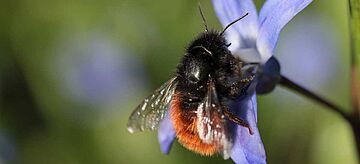
Mason bee on a flower
| Assessment type | Topic | Year |
|---|---|---|
Thematic report | Underlying Causes of Biodiversity Loss and the Determinants of Transformative Change and Options for Achieving the 2050 Vision for Biodiversity (Transformative Change Assessment) | 2024 |
Thematic report | Interlinkages among Biodiversity, Water, Food and Health (Nexus Assessment) | 2024 |
Thematic report | Invasive Alien Species and their Control | 2023 |
Thematic report | The Sustainable Use of Wild Species | 2022 |
Thematic report | The Diverse Values and Valuation of Nature | 2022 |
| Global report | Biodiversity and Ecosystem Services | 2019 |
| Regional and sub-regional report | Africa | 2018 |
| North, South and Central America (the Americas) | 2018 | |
| Asia and the Pacific | 2018 | |
| Europe and Central Asia | 2018 | |
| Thematic report | Pollinators, Pollination and Food Production | 2016 |
| Land Degradation and Restoration | 2018 | |
| Methodological report | Scenarios and Models of Biodiversity and Ecosystem Services | 2017 |
Core messages of the global report
- Biological diversity and ecosystem services such as food, clean water and medicine are essential for human survival.
- However, their present state is deteriorating dramatically: today, the rate of species extinction is at least dozens to hundreds of times higher than the average over the past 10 million years
- 75 percent of the land surface and 66 percent of the ocean area have been significantly altered; over 85 percent of the world’s wetlands have been lost
- These negative trends are being driven by numerous factors such as changes in land use, pollution and climate change
- Indirect drivers, such as social and political factors, are a good starting point for measures at all levels of society
- The Platform’s next work programme up to 2030 was also adopted at the plenary session
Thematic assessment reports
The first thematic assessment report, which focusses on pollinators, pollination and food production, was drawn up in 2016.
Its core messages are:
- The production of many high-quality food crops, primarily fruit and vegetables, is reliant on pollination
- For some years now, many regions around the world have been experiencing a drastic decline in pollinators
- The dramatic loss of bee colonies occurs differently in Europe, North America and other world regions
- Intensive agricultural production and, in particular, the use of pesticides poses major threats to pollinators and pollination
- Another thematic assessment report on land degradation* and restoration was concluded in 2018. Its core messages are: the steady expansion and unsustainable management of cropland and grazing land is the largest direct cause of land degradation globally, resulting in a significant loss of biodiversity and ecosystem services
- Land degradation has reached critical levels in many parts of the world; wetlands, for example bogs, are particularly severely affected
- Increasing demand for food and biofuels will likely lead to increasing land degradation in the future
- Preventing, reducing and reversing land degradation could reduce greenhouse gas emissions by more than a third by 2030
* Land degradation: loss or decline of biological diversity in terrestrial ecosystems (for example in tropical rain forests, deserts and tundras) and their associated aquatic ecosystems (for example lakes and rivers)
Organisational structure of IPBES
IPBES is made up of several bodies carrying out various functions and responsibilities. These bodies work together to give scientific advice to policymakers on biodiversity and the services ecosystems provide to people (for example clean water, clean air, healthy food, wood and other raw materials).
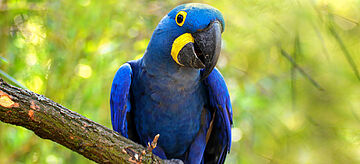
Anodorhynchus in flight
Plenary and plenary sessions
The IPBES plenary is the Platform’s governing body. It convenes every one to two years. The plenary is the general assembly of all IPBES member states where fundamental and strategic decisions are taken. Ministry representatives from the member states and accredited participating organisations take part in the plenary sessions. At the sessions, decisions are made on leadership roles, expert groups and task forces, procedural points, the work programme and the budget. The plenary also decides on the scope and structure of the IPBES assessment reports. It is supported by two lower-level bodies: the Bureau (administration) and the Multidisciplinary Expert Panel (MEP).
IPBES Bureau
The IPBES Bureau is comprised of two representatives from each of the five UN regions. In between plenary sessions, the Bureau takes decisions related to the IPBES plenary decisions. The Bureau drafts documents in preparation for the meeting and chairs the sessions.
Multidisciplinary Expert Panel (MEP)
The Multidisciplinary Expert Panel provides the IPBES with coordinated scientific advice, including advice on the current work programme. The plenary elects MEP members for a period of two years. The MEP comprises equal numbers of representatives from the five UN regions.
Expert groups and taskforces
Expert groups and task forces are established for a limited period of time to ensure successful implementation of the work programme. They draw up reports including the thematic, regional and global IPBES assessment reports.
Secretariat
The secretariat plays an operational role and is based in Bonn. One of its main responsibilities is to organise and coordinate implementation of the IPBES work programme. It is entrusted with other tasks by the plenary and prepares its meetings.
National Focal Points
All IBPES member states are encouraged to establish National Focal Points. The National Focal Point nominates national experts for the IPBES deliverables and coordinates the national assessment process in which different ministries and authorities are involved. In Germany, the National Focal Point is located within the Federal Environment Ministry.
IPBES plenary session outcomes
The IPBES plenary is the Platform’s governing body. It convenes once a year and takes fundamental and strategic decisions. Ministry representatives from the member states and accredited participating organisations take part in the plenary sessions.
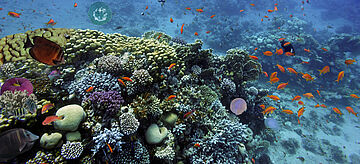
Fish swarm in the coral reef
Overview
IPBES workshops
Since its formation, IPBES has organised two workshops: a workshop on biodiversity and pandemics and, together with IPCC, a workshop on biodiversity and climate change. Both workshop reports were presented to the 8th IPBES plenary session in 2021 for information.
2020 IPBES workshop on biodiversity and pandemics
In the spring of 2020, against the backdrop of the emerging novel coronavirus, the IPBES Bureau and the Multidisciplinary Expert Panel (MEP) decided to hold a platform workshop on the link between biodiversity and pandemics in July 2020 in accordance with IPBES procedures. In line with decision IPBES-3/3 annex I, platform workshops can be organised to support activities that have already been adopted by the IPBES plenary to have, for example, a limited number of selected experts assess a specific topic in more detail. In the case of the workshop on biodiversity and pandemics, the aim is to mainly use the outcomes to support the ongoing preparations (scoping) for the implementation of the IPBES nexus assessment. The outcomes outlined in the workshop report were neither discussed nor approved by the plenary.
IPBES-IPCC 2020 workshop on biodiversity and climate change
Approximately 50 leading global experts on biodiversity and climate from all regions of the world took part in the workshop on the links between biodiversity and climate change. At the suggestion of the IPBES plenary, the workshop took place in 2020. It could lead to future joint initiatives, which, however, would still have to be assessed by IPBES and IPCC member states. The workshop outcomes build on IPBES and IPCC assessment and special reports and the latest scientific literature. Numerous external experts have reviewed the joint workshop report. However, it was drafted without the participation of the member states in the review process and was not adopted by them. The workshop report therefore does not have the same status as an IPCC or IPBES assessment report.
Germany's contribution to IPBES

Wildcat with pup
International IPBES activities
As the IPBES host country, Germany attaches great importance to supporting IPBES, for example by providing one million euros annually for the trust fund to carry out the IPBES work programme. In addition, when the plenary meets in Germany, Germany covers a large share of the conference costs. This makes Germany one of the main funders of IPBES.
Germany also supports capacity building as part of the International Climate Initiative (IKI), for example IPBES-related networking among experts in various regions of the world. The CABES project aims to strengthen the competences required for the IPBES work programme in West, Central and East Africa. It informs national policy-making processes on implementing processes for improving management and ensuring the sustainable use of biodiversity and ecosystem services. Furthermore, the project is establishing a network of science-policy advisory platforms to help implement the tasks of IPBES at various levels. The Biodiversity and Ecosystem Services Network (BES-Net phase II) is also supported through the International Climate Initiative (IKI). One of the measures is advising eighteen countries on implementing the findings of IPBES assessments and/or national ecosystem assessments through policy, the scientific community and in practice. From 2016 to 2019, Germany co-financed the Technical Support Unit for the global assessment report in the IPBES Secretariat. German experts have also worked on every IPBES assessment report.
German IPBES Coordination Office
The German IPBES Coordination Office was set up in early 2014 by the Federal Environment Ministry (BMUKN) and the Federal Research Ministry (BMFTR). It acts as the link between the international IPBES bodies, the BMUKN as the IPBES National Focal Point and German scientists in the field of biodiversity and ecosystem services. The Coordination Office keeps German scientists informed about international and national IPBES processes. It is responsible for coordinating the process for nominating German experts. Another of the office’s key tasks is public relations work. It also organises various stakeholder events. Beyond this, the German IPBES Coordination Office supports the IPBES National Focal Point in the BMUKN. The German IPBES Coordination Office is housed by the executing agency of the German Aerospace Center (DLR).
National forums on IPBES
In the run-up to the international IPBES plenary sessions, the Federal Environment Ministry and Federal Research Ministry hosted a national forum on IPBES. These forums facilitate dialogue between the scientific community, politics and the general public in Germany. German scientists, for example, speak about their work in the IPBES bodies and present various draft scoping reports and assessments. The national forums also helped prepare the German position for the upcoming IPBES plenary sessions. For the first time, from February 2026 the national forum will be held after the plenary session to increase the impact and encourage the use of the adopted assessment reports at national level. Current information about the national forums on IPBES can be found on the website of the German IPBES Coordination Office.