

Agreements signed for closer cooperation on wetlands conservation and climate adaptation
Federal Environment Minister Carsten Schneider and his Indian counterpart, Bhupender Yadav, jointly kicked off the 4th Indo-German Environment Forum in New Delhi yesterday and signed a Joint Declaration of Intent to step up cooperation on wetlands conservation. Germany and India aim to promote more climate-resilient and sustainable development in the protection of wetlands. The two ministers have also agreed to deepen their technical cooperation on climate adaptation. The goal is to share successful approaches and learn from each other's experiences. The Environment Forum, organised together with business associations from both countries, focused on the enormous potential of environmental technologies and circular economy, and on how Germany and India can jointly develop markets while strengthening the competitiveness and resilience of both economies.
Federal Environment Minister Carsten Schneider remarked: "Given the challenging situation globally, we need reliable and strong partners like India. We have long been united by our commitment to multilateralism, which is essential for successful global environmental protection and climate action. We have chosen "Together for more resilience" as the title for this year's Environment Forum, as we share the goal of making our countries more resilient – particularly to the impacts of climate change. These impacts jeopardise economic growth and threaten entire industries. We want to step up this cooperation in future. This is because we need to both protect the natural foundations of life and promote our individual economies German companies are leaders in the clean tech sector, which is undergoing a boom in India and helping to provide affordable electricity and clean water."
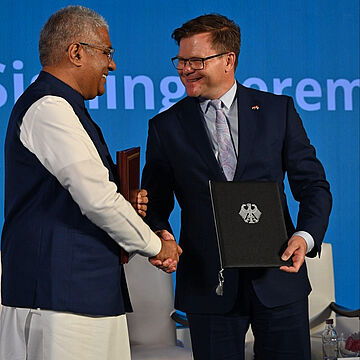
The Joint Declaration of Intent underscores our commitment to the international conventions on biodiversity (CBD) and the conservation and sustainable use of wetlands (Ramsar Convention). India and Germany plan to develop partnership models involving the public and the private sector to protect wetlands and promote wetlands-based livelihoods and ecotourism. Other goals include joint research initiatives, scientific cooperation and digital technologies for monitoring and managing wetlands.
The closer technical cooperation on climate adaptation also comes in the wake of the recent heatwaves this summer in Europe and their impacts in Germany. In India, climate resilience has long been a key issue.
This trip also marked Minister Schneider's inaugural visit to India. In addition to talks with his Indian counterpart, Bhupender Yadav, he met with the Minister for Commerce and Industry, Piyush Goyal, and the Minister of Power, Manohar Lal. In Alwar (in the state of Rajasthan), he visited a project aimed at restoring and conserving forests and tree populations, and spoke to local communities. His itinerary also included discussions with representatives from associations, institutions and companies operating in India. The minister was accompanied by a business delegation.
This year's Indo-German Environment Forum, “Together for more resilience”, focused on circular economy, biodiversity, climate action and adaptation, clean tech and sustainable financing. It showed just how closely environmental sustainability, long-term economic prosperity and energy security are linked. The Indo-German Environment Forum is the highest-level bilateral format of the two countries in the field of environmental policy and has been held regularly since 2008. It is jointly organised by the two environment ministries (Federal Ministry for the Environment, Climate Action, Nature Conservation and Nuclear Safety and the Ministry of Environment, Forest and Climate Change), together with the Asia-Pacific Committee of German Business (APA) and Indian business associations. India is the world’s largest location of the German Chambers of Commerce Abroad (AHK). There are around 2,000 German companies with subsidiaries in India, with some 700 of them producing locally.