
– Check against delivery –
Minister Murat Kurum,
Minister Chris Bowen,
Excellencies,
Colleagues,
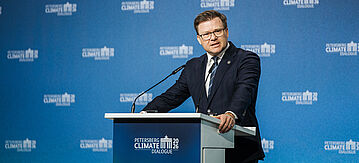
It gives me great pleasure to welcome you to the seventeenth Petersberg Climate Dialogue, here in Berlin, at Westhafen. It is an old industrial area, as you can see.
Chris, it is a pity that you couldn’t join us here in Berlin. But we understand with the current situation in Australia that you had to cancel you trip at short notice. We are delighted that you are able to join us online.
This is the first ministerial conference since Belém. From there we sent an important signal for multilateralism. That signal has perhaps become even more important now. The world is in turmoil. The situation is serious.
We are experiencing wars that are causing great human suffering. And, for the second time in a short period, we are seeing how volatile fossil energy markets are. The prices of the fossil fuels oil, gas and coal have risen massively. A number of countries are rationing fossil fuels. Some businesses have curbed production.
It is clear that this crisis is a fossil fuel crisis. Fossil fuels do not offer the security of supply that is so urgently needed by people, businesses, economies and global supply chains. Those who rely on importing oil and gas today are exposing themselves to incalculable risks.
Renewable energy sources, on the other hand, are security energies. This is another reason why we must speed up the expansion of renewables – for our security and for the climate.
Increased renewable energy use and energy efficiency are a core component of a broader understanding of security.
Available, more cost-effective renewable energy counteracts energy poverty. And it strengthens energy security and sovereignty.
It ensures economic resilience, added value and employment – for manufacturers worldwide and locally and also for craftspeople around the corner.
It creates climate security. If we expand renewables quickly enough, it will be our strongest lever in mitigating climate change.
Particularly in this crisis, we also see that the global energy transition is well advanced and cannot be stopped. But we need to pick up the pace and do even better.
Because our planet continues to heat up. The eleven years since 2015 have been the warmest on record. Our oceans are breaking temperature records year after year. These are not just abstract numbers. They represent millions of lives and livelihoods that are threatened by heat, drought and floods worldwide. The costs are in the billions.
We therefore need climate action to secure livelihoods and development opportunities. And to make use of the enormous opportunities to modernise our economies and society. Our joint mission is to close the gap in measures that still separates us from the 1.5-degree limit.
Delaying the transformation would carry enormous risks. For our health and security, for nature and for the economy. The cost of inaction is high. Beyond 1.5 degrees, adaptation becomes increasingly difficult and, at some point, impossible.
The COPs of recent years have set out what needs to be done: Speed up the phase-out of fossil fuels. Triple renewable energy capacity. Double energy efficiency. We have all the tools we need to do this.
Last but not least, I would like to highlight the role of nature. Healthy ecosystems are our allies in climate change mitigation because they store carbon. That is why, in Germany, we are strengthening nature with our Action Plan on Nature-based Solutions for Climate and Biodiversity. Peatlands and forests, floodplains and seas all help mitigate climate change. We need to take advantage of this globally and, for example, halt deforestation by 2030 as agreed.
In recent years, we have also made further important progress internationally in harnessing synergies between climate action and nature conservation. In 2022, at the COP in Sharm El-Sheikh, we endorsed the Mangrove Breakthrough, which aims to restore 15 million hectares of mangroves. And in Belém last year, Germany was part of the Peatland Breakthrough which seeks to rewet peatlands worldwide and make an enormous contribution to climate change mitigation.
We are all feeling the pressure on climate policy. Sometimes, our climate efforts are at risk of being overwhelmed by all the other crises. At the same time, people want us to make progress on climate action. In Germany, a recent study showed that more than 70 percent of respondents feel it is the right decision to become climate neutral by 2045. Just because the opponents are often louder does not mean they are the majority.
It is important now to create clear, reliable framework conditions throughout the world for the path to climate neutrality. We need a level playing field.
One example is the Climate Club with its 48 members. Here we show how we can jointly advance the development of lead markets for green steel and cement. It is about seizing the opportunities of decarbonisation, and mitigating risks together.
Europe wants to become the first climate neutral continent by 2050. The EU targets are ambitious but necessary. The goal is to cut emissions by 90 percent by the year 2040. This target has been endorsed by all European players, by the European Parliament and the heads of state and government. A strong and reliable emissions trading system remains the central pillar for this.
In Germany, we are pressing ahead with the energy transition. Today, nearly 60 percent of our electricity supply comes from renewable energy sources.
Coal-fired power plants are closing and we are reducing our use of gas.
Together with our neighbours, we operate one of the most stable electricity grids in the world. Our guiding principle is electrification not combustion – in industry, transport and buildings. This makes us more resilient and more efficient.
Here at the PCD, I would like to start a discussion on electrification. What can we do together to electrify our economies? What do we want to tackle before COP31 in Antalya? How exactly can we successfully advance this topic? I would like to discuss this with you.
Electrification is already a global megatrend. For us, and for most investors, it is clear that the electricity for this must come from renewable sources. More than 90 percent of all global investments in new power generation capacities go to renewables. All of us here in this room have chosen, with good reason, to promote renewables. These are indispensable investments in the future.
At the same time, for climate policy to work, it has to be fair. We all have to address this challenge. Climate action must not leave anyone behind. It must open up possibilities for everyone. Climate action is the major social question of the twenty-first century.
We are increasingly feeling the impacts of climate change. That is why we need measures for resilience and adaptation. Here, too, there is a strong social dimension. People with fewer resources are often hardest hit by the impacts of climate change. We owe these people support and a clear strategy.
At previous COPs, we set out to improve climate finance and triple finance for adaptation measures. This is a mission we accept – even in times of tight budgets.
The transformation of our economies poses major challenges, especially for developing countries and emerging economies. Germany will continue to stand by and support our partners in the future. It is also clear that public funding alone will not be enough. So let us work together to expand private investments. And more importantly, to implement national adaptation plans and NDCs.
In times like these we see what the Petersberg Climate Dialogue stands for. The PCD has a long tradition of bringing us together in difficult times, so that together we can find a way forward.
Looking around this room today gives me courage and confidence. I would like to thank you all for coming to Berlin and I look forward to the next two days.
New paths of course require input from all angles. Being honest, the all-male group here opening the PCD is somewhat limited in this regard. But I am confident that – after the formal opening – our female colleagues here in the room will make their voices heard.
So, over the next two days, let’s roll up our sleeves and get to work. Let’s show that multilateralism is alive and kicking and delivers results. Let’s set the course together for a successful COP31, for effective international climate cooperation and for consistent implementation of the Paris Agreement. It is now a great pleasure and honour for me to give the floor to our co-hosts of this year’s Petersberg Climate Dialogue: Minister Murat Kurum on behalf of Türkiye, the designated COP31 Presidency, and Minister Chris Bowen on behalf of Australia, the designated COP31 President of Negotiations.