Economy and Environment are two sides of the same coin. Economy and ecology have been unjustly conceived as opposing elements for too long. On the contrary, ecology and economy belong together. A healthy environment and a sparing and careful use of natural resources are prerequisites for a stable economic and social development in the long term.
Germany and India aim to promote more climate-resilient and sustainable development in the protection of wetlands. The two countries have also agreed to engage in closer technical cooperation on climate adaptation.
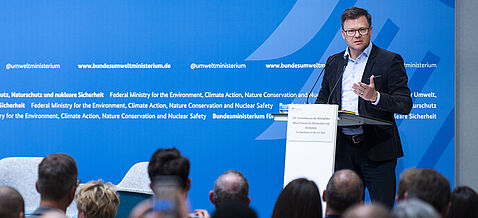
The main object of the visit is the 4th Indo-German Environment Forum under the theme "Together For More Resilience". Minister Schneider will open the Forum with his Indian counterpart in New Delhi.
Emissions trading, as the European Union’s key climate protection instrument, is to be further strengthened and aligned with the European climate target for 2040 and climate neutrality in Europe by 2050 at the latest.
The focus of the conference is on the crucial importance of environmental protection and climate action for achieving the UN Sustainable Development Goals and to send a clear message against deep-sea mining.
Germany, France and the Netherlands are advocating coordinated European action against ultra-fast fashion. The three Member States raised the topic at the EU Environment Council in Luxembourg.
At the conference around 180 experts from the scientific community, politics, companies and industry and environmental associations are discussing measures and potential for scaling up new carbon removal technologies.
From June 8-18, the UN interim negotiations (SB64) in Bonn prepare for COP31. Thousands of delegates negotiate on emissions reductions, climate finance, and phasing out fossil fuels.
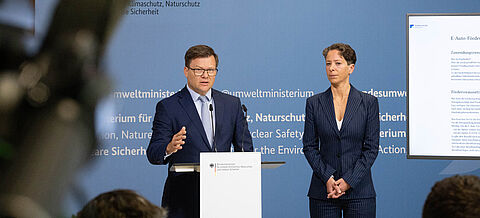
The portal for the new electric car subsidy program for private individuals is now online. The BMUKN and BAFA are using modern, digital, and citizen-friendly administrative processes for the program.