
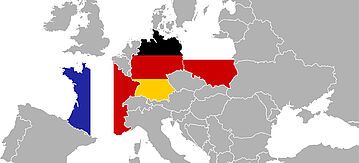
On 28-29 September 2026, the Environment Ministers of Poland, Germany and France met at the Château de Chambord as part of the Green Weimar Triangle, a framework for strengthening trilateral cooperation on climate and environmental issues. Building on the meeting held in Gniezno in March 2026, the three Ministers reaffirmed the importance of closer cooperation between the three countries ahead of major European and international milestones, including the upcoming biodiversity and climate COPs and the EU Environment Councils in October and December.
Building Europe’s resilience through climate action and nature restoration
The growing impacts of climate change underline that mitigation must go hand in hand with stronger adaptation and resilience, particularly in the area of water management. Recent extreme weather events across Europe have demonstrated the increasing risks posed by heatwaves, droughts, floods and wildfires to populations, ecosystems, infrastructure, and economic activity. The Ministers highlighted the importance of strengthening preparedness and integrating climate risks more systematically into European policies. They stressed that nature-based solutions should be prioritised, also in view of their role in strengthening the EU’s security. They also called for a common EU adaptation framework.
In parallel, the implementation of the European Nature Restoration Regulation will be an important lever for strengthening Europe’s resilience, by restoring and enhancing natural ecosystems and their capacity to withstand climate impacts and protect our economies. Against this background, the Ministers discussed the challenges of implementing the Nature Restoration Regulation and highlighted the importance of mobilising EU funding to that end, including in the next Multiannual Financial Framework.
Achieving climate neutrality for a stronger and more sovereign Europe
The Ministers stressed the importance of elements of the European climate policy framework consistent with the EU climate law and the 2040 objective and with the European Union’s objective of achieving climate neutrality by 2050, and providing a clear and predictable pathway for the transformation of the European economy. They exchanged views on the future post-2030 climate framework and on the instruments needed to reach the 2040 target while safeguarding Europe’s industrial competitiveness, supporting innovation, strengthening economic security and preventing deindustrialization risks.
The Ministers discussed the importance of the ongoing discussions on the EU Commission’s proposal on the EU ETS, which is essential to Europe’s pathway to climate neutrality, and provides a reliable price signal to mobilise investment in low-carbon technologies and the transformation of production processes. They stressed the need for social acceptance, to ensure protection of the poorest and the need for adjustments to the EU Emissions Trading System (ETS) to better support the competitiveness of European industry, mitigate the risk of carbon leakage and de-industrialisation, provide greater predictability for investment, and contribute to Europe's economic security and resilience while delivering climate objectives.
The Ministers also called on the European Commission to put forward a European solution to ensure that sectors covered by the Carbon Border Adjustment Mechanism (CBAM) continue to receive adequate protection against carbon leakage, including through a solution addressing the export-related carbon leakage risks.
Turning this ambition into reality will also depend on Europe’s ability to strengthen both its energy security and sovereignty, notably by reducing Europe’s dependence on imported fossil fuels, and its industrial competitiveness and resilience. In particular, the transition to electric mobility, supported by a strong European industrial base, including the automotive and battery industry, was highlighted as a strategic priority. The Ministers agreed on the importance to find a compromise on the CO2 standards for cars and vans regulation, on the basis of the Commission’s proposal in line with these objectives. They also underlined the importance to speed up the development of a trilateral truck charging corridor until 2030 as an important step to achieving climate targets in the transport sector. They agreed to work closely with the Ministers of Transport to this end with the aim of developing a joint infrastructure roadmap.
Cooperating further to achieve ambitious outcomes in biodiversity, climate and plastic pollution at the global level.
The Ministers underlined the importance of a strong and united European voice in multilateral processes. In light of the worsening impacts of climate change in Europe and worldwide, they reaffirmed their shared determination to supporting global efforts to address the climate crisis and to strengthening international cooperation under the UNFCCC. In particular, they highlighted the importance of maintaining momentum on mitigation, advancing the implementation of GST1 outcomes, preparing for GST2, and furthering discussions on reforms needed to ensure that the UNFCCC process remains fit for purpose in the implementation era. They further promoted an ambitious climate agenda, and called for COP31 to address the transition away from fossil fuels and clean electrification, increase action on methane emissions, and reaffirmed their support for a calendar for the IPCC reports coherent with the global stocktake scheduled for COP33.
In a context where global biodiversity is facing huge threats, they stressed the importance of the upcoming COP17 on biodiversity, and called for an ambitious, transparent and honest global review of the progress achieved towards the targets of the Kunming-Montreal Global Framework. They look forward to the resumption of negotiations on the international treaty to end plastic pollution, and called for an ambitious and action-oriented treaty that addresses the root causes of plastic pollution, including production and consumption. They discussed on concrete goals and possible packages that address the full lifecycle. They exchanged on a phase-out of landfills combined with ending the inputs of macroplastic pollution, each with a concrete deadline. They agreed on the importance of product design including chemicals of concern. They also agreed that any anchor in the treaty would only work if the decision-making rules for the COP will not lead to the next deadlock, including an anchor to address production.
On these processes, they also agreed that while international solidarity remains a priority, financial efforts will also depend on the level of ambition showed by all parties and that the donor base needs to reflect current 21st century realities.
Finally, the three Ministers reaffirmed their intention to continue their close cooperation within the Green Weimar Triangle and to keep coordinating ahead of key European and international discussions